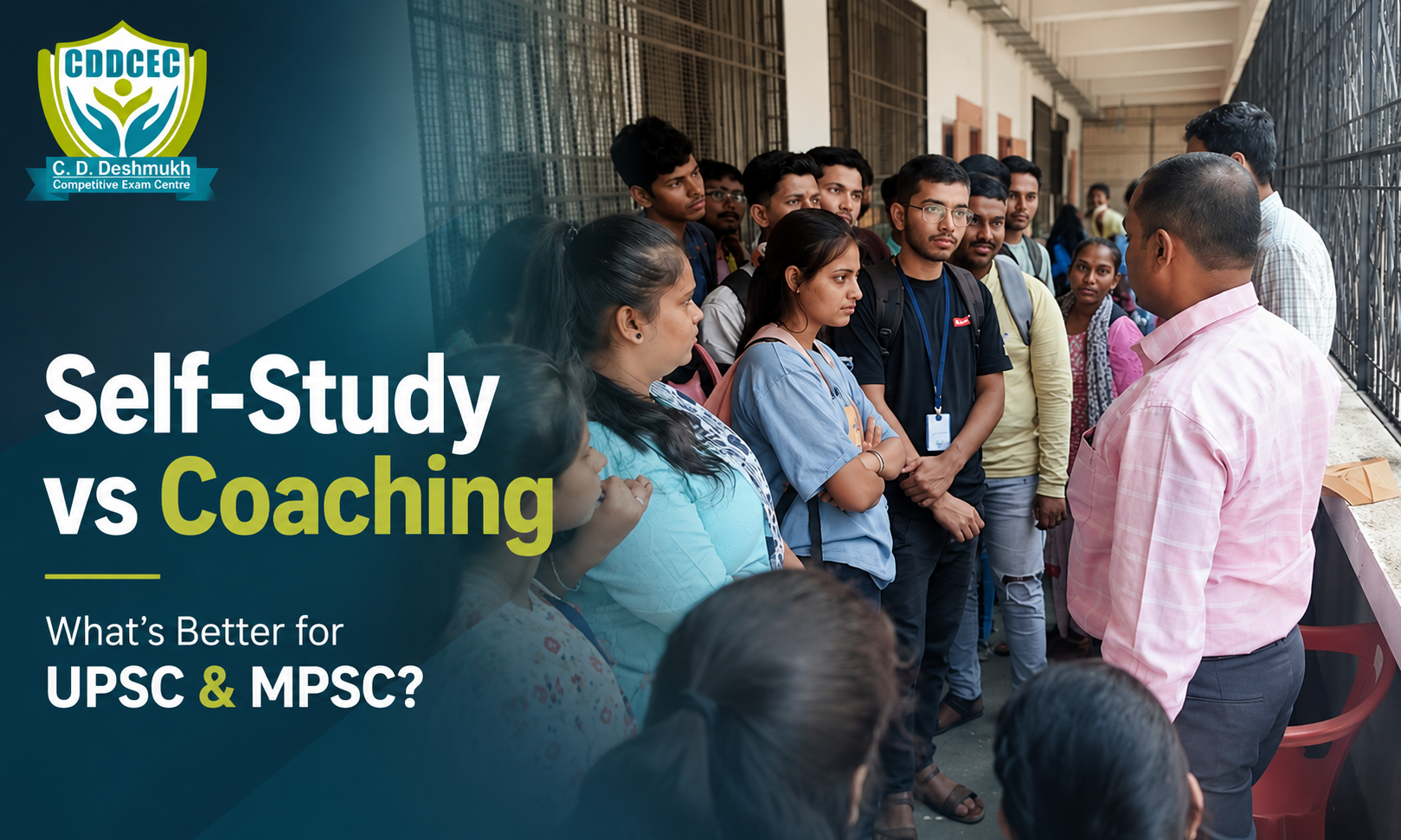

Somewhere in Thane right now, an aspirant has just finished watching a YouTube video titled “I cleared UPSC with zero coaching.” Right below it, the algorithm has helpfully queued up another video, this one from a topper who credits their coaching institute for “everything.” Two screens, two completely opposite stories, both claiming to hold the answer. That contradiction is exactly where the self-study vs coaching UPSC debate gets confusing, and exactly where most aspirants start second-guessing a decision they haven’t even fully thought through yet.
Here’s where things get interesting: this isn’t really a debate with a single winner. It’s a question of fit, your background, your discipline, your access to resources, and how much structure you genuinely need to stay consistent over a year or two of preparation.
The Real Question Isn’t Self-Study vs Coaching, It’s What Each One Actually Solves
In our experience working with aspirants across UPSC, MPSC, and allied exams, the strongest candidates don’t pick a side out of loyalty to a method. They pick based on what’s actually missing in their preparation. Self-study and coaching aren’t opposing philosophies; they solve different problems. Once you separate what each one is genuinely good at, the choice becomes far less emotional and far more practical.
What Self-Study Genuinely Gets Right
Flexibility and Pace Control
Self-study lets you move at your own pace, slowing down on subjects you find difficult and accelerating through those you’ve already mastered. For working professionals or aspirants managing other commitments, this flexibility is often non-negotiable.
Deeper Ownership of Learning
There’s a certain depth that comes from wrestling with a concept on your own before someone explains it to you. Aspirants who self-study often develop stronger independent analytical skills, which show up in how they construct answers under pressure.
Lower Cost
This one’s straightforward, self-study, especially when built around NCERTs, standard reference books, and free current affairs resources, costs a fraction of what structured coaching does.
Where Self-Study Quietly Falls Short
What most people don’t realise until they’re a few months in is that self-study’s biggest weakness isn’t motivation, it’s the absence of an external benchmark.
No Way to Know Where You Actually Stand
Reading and understanding a topic feels like progress. But UPSC and MPSC don’t test understanding in isolation; they test your ability to recall, structure, and write under time pressure. Without mock tests and evaluated answer sheets, most self-study aspirants discover the gap between “I know this” and “I can write this in 7 minutes” far too late.
Current Affairs and Shifting Patterns
Exam patterns evolve. Question framing shifts. What got a topper through three years ago may not align with this year’s paper. Self-study aspirants working alone often miss these shifts simply because there’s no one actively tracking and translating them into a preparation strategy.
The Answer-Writing Feedback Gap
This is arguably the single biggest blind spot. You can read a thousand pages on Polity, but if no one is reviewing your written answers, pointing out vague structure, weak introductions, or missed keywords, that gap stays invisible until the result is out.
Isolation Over a Long Preparation Window
UPSC and MPSC preparation isn’t a sprint. It’s an 18–24-month process with inevitable low phases. Self-study aspirants, especially those without a peer group, often underestimate how much consistency depends on having people around who understand exactly what you’re going through.
What Coaching Actually Adds, Beyond Just Teaching
Structured, Personalised Study Plans
Rather than guessing what to study and when, a well-designed coaching plan sequences your preparation , foundation building, optional subject depth, current affairs integration, and revision cycles , based on your timeline and current level.
Mock Tests With Real Evaluation
This is where the self-study gap closes fastest. Regular mock tests, evaluated by experienced faculty, give you the one thing self-study almost never offers: an honest, repeated benchmark of where you stand.
Mentorship Through the Difficult Stretches
In our experience, this matters more than aspirants expect going in. Having faculty who’ve guided hundreds of students through the same exam, and who can recognise when someone’s preparation strategy needs adjusting, not just their content knowledge, often makes the difference between giving up and pushing through.
A Peer Environment That Keeps You Honest
Preparing alongside other serious aspirants creates a quiet accountability that’s hard to replicate on one’s own. It also exposes you to different ways of approaching the same question, which sharpens your own answer-writing.
So, Self-Study or coaching- how do you actually decide?
If you’re highly self-disciplined, have prior exposure to the syllabus, and primarily need content rather than structure, self-study can absolutely work; many toppers have proven that. But if you’re newer to the exam, need consistent evaluation, or struggle to maintain momentum without external accountability, coaching tends to close gaps faster and more reliably. The honest answer to the question of self-study vs. coaching for UPSC, for most aspirants, lies somewhere in between: self-study for content absorption, paired with structured coaching for testing, feedback, and mentorship.
For Aspirants Looking for UPSC Coaching in Mumbai and the Thane Region
If you’re based in Thane or anywhere across the Mumbai region and weighing this exact decision, you don’t have to choose blindly. At C.D. Deshmukh Coaching Classes, we work with aspirants who come from both ends of this spectrum: some who’ve self-studied for a year and need test series and answer evaluation to close the gap, and others who want comprehensive guidance from day one. Our faculty build personalised study plans around where you already stand, rather than starting everyone from the same blank page.
If you’re still unsure which approach fits you, sitting in on a demo lecture is a low-pressure way to find out. Sometimes, the clearest way to answer self-study vs coaching for yourself is to experience what structured mentorship actually feels like before deciding you don’t need it.