
Every year, thousands of banking aspirants sit down with a notepad, open two browser tabs — one for IBPS, one for SBI — and spend more time comparing the two than actually preparing for either. It is a familiar trap. Both exams look similar on the surface. Both lead to the same destination: a Probationary Officer role at a public sector bank. So which one do you go after first?
The honest answer is: it depends on who you are, where you are in your preparation, and what kind of banking career you actually want. But to make that call well, you need to understand the real differences between these two exams — not just the syllabus comparison that every generic article gives you, but the strategic differences that actually affect your preparation timeline and your chances.
Let’s break it down properly.
What You Are Actually Choosing Between
Before diving into exam patterns and cutoffs, understand the fundamental distinction.
SBI PO is a single-bank exam. You are applying to become a Probationary Officer, specifically at the State Bank of India — India’s largest public sector bank, with over 22,000 branches and a global footprint. SBI conducts its own exam independently, sets its own standards, and has its own career progression structure.
IBPS PO is a common recruitment exam conducted by the Institute of Banking Personnel Selection. Clear IBPS PO, and you become eligible for appointment across 11 nationalised banks — including Punjab National Bank, Bank of Baroda, Canara Bank, Union Bank, and others. One exam, multiple bank options.
This distinction matters more than most people realise when choosing which exam to target first.
IBPS PO Exam Details: Structure and Pattern
The IBPS PO exam follows a three-stage structure:
Stage 1 — Preliminary Exam: 100 questions, 100 marks, 60-minute duration. Three sections: English Language (30 questions), Quantitative Aptitude (35 questions), and Reasoning Ability (35 questions). Each section has its own time limit — typically 20 minutes each.
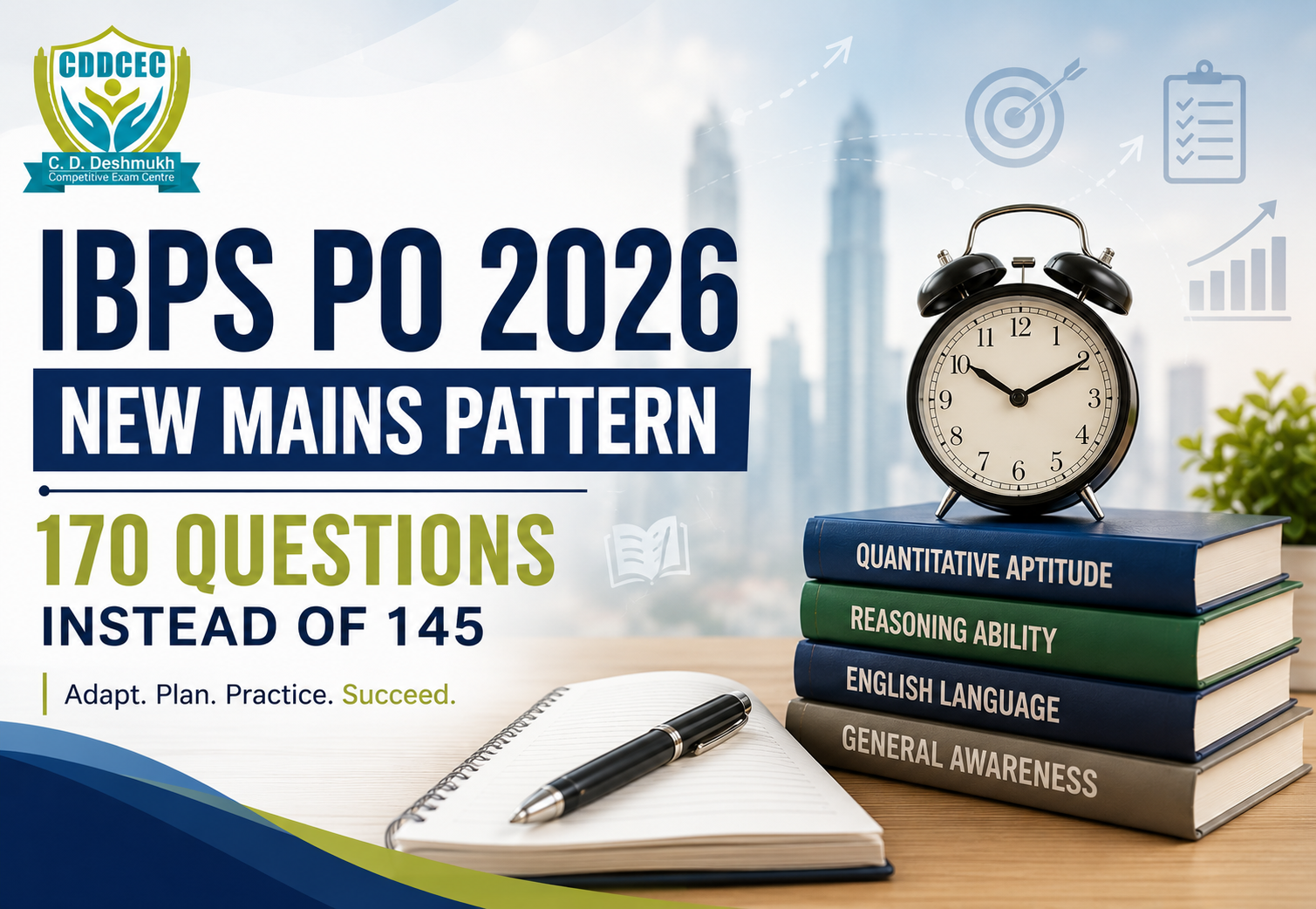
Stage 2 — Mains Exam: This is where the IBPS PO exam details get more demanding. The Mains consists of four objective sections — Reasoning & Computer Aptitude (45 questions, 60 minutes), English Language (35 questions, 40 minutes), Data Analysis & Interpretation (35 questions, 45 minutes), and General/Economy/Banking Awareness (40 questions, 35 minutes). Total: 200 marks across 3 hours.
There is also a Descriptive Paper — a 30-minute Letter Writing and Essay component — conducted online immediately after the objective sections. This is evaluated only for candidates who clear the objective cutoff.
Stage 3 — Interview: Shortlisted candidates appear for a personal interview. Final merit is calculated on an 80:20 ratio — Mains score carries 80% weightage, and Interview carries 20%.
IBPS PO Exam Notifications: IBPS typically releases notifications between July and August each year, with Prelims usually held in October and Mains in November. Results and provisional allotments come early the following year.
SBI PO Exam Pattern: Where It Differs
The SBI PO exam pattern is structurally similar to IBPS PO — three stages, Prelims followed by Mains followed by Interview — but the differences in content and evaluation are significant.
Stage 1 — Preliminary Exam: Identical structure to IBPS PO Prelims. 100 questions, 100 marks, 60 minutes, with sectional time limits.
Stage 2 — Mains Exam: The SBI PO exam pattern at the Mains stage is noticeably more challenging. The objective sections cover Reasoning & Computer Aptitude, Data Analysis & Interpretation, General/Economy/Banking Awareness, and English Language — broadly similar to IBPS. However, SBI also includes a Data Analysis section that tends to be more calculation-heavy and a Reasoning section that tests higher-order logical thinking.
The Descriptive Paper is again a 30-minute component — Letter Writing and Essay —, but SBI’s essay prompts tend to be more opinion-based and require a stronger grasp of current affairs and economic understanding.
Stage 3 — Group Exercise + Interview: Here is where the SBI PO exam pattern diverges most sharply. SBI conducts a Group Discussion or Group Exercise round before the interview — a structured activity where candidates are observed for leadership, communication, and team behaviour. The final selection score carries 50% weightage from Mains and 50% from GE + Interview combined.
SBI typically notifies its PO recruitment between February and April, with Prelims in June–July and Mains in August. The timeline is distinct from IBPS, which means both exams can potentially be attempted in the same calendar year.
The Real Differences That Affect Your Strategy
Difficulty Level
In our experience working with banking aspirants, SBI PO is consistently perceived as the harder exam — and the data supports this perception. The cutoffs for IBPS PO are generally more accessible, the question difficulty in Mains is slightly lower, and the volume of vacancies across 11 banks means more total seats than SBI PO alone.
This does not mean IBPS PO is easy. It means the relative difficulty curve is gentler, and the margin for error is slightly wider.
Competition Intensity
Both exams attract lakhs of applicants. SBI PO sees more aspirants per vacancy because of SBI’s brand prestige — many candidates view it as the gold standard of public sector banking. IBPS PO, while equally competitive in aggregate, distributes competition across a larger vacancy pool.
Career Trajectory
This is the factor that gets the least attention in most comparisons of IBPS PO vs SBI PO — and it deserves more.
SBI has one of the steepest but most rewarding internal career tracks in Indian banking. SBI POs typically get faster lateral exposure, more structured training programs, and opportunities that a nationalised bank under the IBPS system may not match in the early years. However, SBI postings are often at branches in remote or Tier-2/3 locations during the probationary period, which is a practical consideration for candidates with location constraints.
IBPS PO gives you bank preferences during allotment — you list your preferred banks and locations, and allotment happens based on merit and preference. This flexibility is meaningful for candidates who have strong location considerations.
The Group Exercise Round
SBI’s Group Exercise is a genuine differentiator. If you are uncomfortable with group dynamics, public articulation, or debate-style environments, this round demands specific preparation that IBPS PO simply does not require. Many candidates who perform well in written rounds underperform here because they have not prepared for it at all.
So Which Should You Target First?
Here is a practical framework based on where most serious aspirants actually stand:
Target IBPS PO first if: You are in the early stages of banking exam preparation and want to build exam temperament before facing SBI’s higher difficulty. IBPS PO Prelims and Mains are excellent real-exam practice grounds. Clearing IBPS PO also gives you a confirmed posting while you continue preparing for SBI — which is the smartest possible position to be in.
Target SBI PO first if: You have already been preparing for 6+ months, your mock test scores in Quantitative Aptitude and Reasoning are consistently strong, and you specifically want SBI. Given the non-overlapping exam calendars, you can attempt SBI PO (June–August) and IBPS PO (October–November) in the same year — so “targeting SBI first” really means treating it as your primary goal while IBPS PO becomes a parallel track.
The most common mistake: Treating these two exams as an either/or decision. They are not. The core preparation — Quant, Reasoning, English, and Banking Awareness — overlaps almost completely. A candidate preparing seriously for one is simultaneously preparing for the other. The only differentiator is the SBI-specific Group Exercise preparation, which you can layer on top of your standard banking prep once you are targeting SBI’s final stages.
What Your Preparation Should Look Like
Whether you begin with IBPS PO or SBI PO, the preparation foundation is identical. Here is how to build it intelligently:
Quantitative Aptitude: Data Interpretation sets are the highest-weightage topic in both Mains exams. Do not spend disproportionate time on simple arithmetic — focus heavily on DI, Quadratic Equations, and Number Series. For SBI PO, push your DI preparation slightly harder, as the calculations tend to be more complex.
Reasoning Ability: Puzzle-based questions dominate both exams. Linear arrangements, circular arrangements, floor-based puzzles, blood relations, and syllogism. Consistent daily practice — 15 to 20 questions — builds the speed and pattern recognition that this section demands.
English Language: Reading Comprehension, Error Spotting, and Sentence Rearrangement are consistent across both exams. Reading quality content daily — newspapers, editorials — simultaneously builds your RC speed and your Descriptive Paper writing quality.
Banking and General Awareness: This section separates serious aspirants from casual ones. Current affairs from the last 6 months, RBI monetary policy updates, recent banking sector appointments, and economic survey highlights are all fair game. Build a daily 20-minute current affairs habit from Day 1 of preparation.
Mock Tests: There is no substitute. Attempt IBPS PO-pattern mocks for general preparation, and specifically use SBI PO-pattern mocks in the months leading up to that exam to calibrate for the difficulty difference. Analyse every test — not just the score, but the errors.
The Bottom Line
The IBPS PO vs SBI PO debate tends to get overcomplicated. Both are outstanding career paths. Both require the same core competencies. The smarter question is not “which one” but “how do I build a preparation system that keeps both options
IBPS PO vs SBI PO: Which Banking Exam Should You Target First?
Every year, thousands of banking aspirants sit down with a notepad, open two browser tabs — one for IBPS, one for SBI — and spend more time comparing the two than actually preparing for either. It is a familiar trap. Both exams look similar on the surface. Both lead to the same destination: a Probationary Officer role at a public sector bank. So which one do you go after first?
The honest answer is: it depends on who you are, where you are in your preparation, and what kind of banking career you actually want. But to make that call well, you need to understand the real differences between these two exams — not just the syllabus comparison that every generic article gives you, but the strategic differences that actually affect your preparation timeline and your chances.
Let’s break it down properly.
What You Are Actually Choosing Between
Before diving into exam patterns and cutoffs, understand the fundamental distinction.
SBI PO is a single-bank exam. You are applying to become a Probationary Officer specifically at the State Bank of India — India’s largest public sector bank, with over 22,000 branches and a global footprint. SBI conducts its own exam independently, sets its own standards, and has its own career progression structure.
IBPS PO is a common recruitment exam conducted by the Institute of Banking Personnel Selection. Clear IBPS PO, and you become eligible for appointment across 11 nationalised banks — including Punjab National Bank, Bank of Baroda, Canara Bank, Union Bank, and others. One exam, multiple bank options.
This distinction matters more than most people realise when choosing which exam to target first.
IBPS PO Exam Details: Structure and Pattern
The IBPS PO exam follows a three-stage structure:
Stage 1 — Preliminary Exam: 100 questions, 100 marks, 60-minute duration. Three sections: English Language (30 questions), Quantitative Aptitude (35 questions), and Reasoning Ability (35 questions). Each section has its own time limit — typically 20 minutes each.
Stage 2 — Mains Exam: This is where the IBPS PO exam details get more demanding. The Mains consists of four objective sections — Reasoning & Computer Aptitude (45 questions, 60 minutes), English Language (35 questions, 40 minutes), Data Analysis & Interpretation (35 questions, 45 minutes), and General/Economy/Banking Awareness (40 questions, 35 minutes). Total: 200 marks across 3 hours.
There is also a Descriptive Paper — a 30-minute Letter Writing and Essay component — conducted online immediately after the objective sections. This is evaluated only for candidates who clear the objective cutoff.
Stage 3 — Interview: Shortlisted candidates appear for a personal interview. Final merit is calculated on a 80:20 ratio — Mains score carries 80% weightage and Interview carries 20%.
IBPS PO Exam Notifications: IBPS typically releases notifications between July and August each year, with Prelims usually held in October and Mains in November. Results and provisional allotments come early the following year.
SBI PO Exam Pattern: Where It Differs
The SBI PO exam pattern is structurally similar to IBPS PO — three stages, Prelims followed by Mains followed by Interview — but the differences in content and evaluation are significant.
Stage 1 — Preliminary Exam: Identical structure to IBPS PO Prelims. 100 questions, 100 marks, 60 minutes, with sectional time limits.
Stage 2 — Mains Exam: The SBI PO exam pattern at the Mains stage is noticeably more challenging. The objective sections cover Reasoning & Computer Aptitude, Data Analysis & Interpretation, General/Economy/Banking Awareness, and English Language — broadly similar to IBPS. However, SBI also includes a Data Analysis section that tends to be more calculation-heavy and a Reasoning section that tests higher-order logical thinking.
The Descriptive Paper is again a 30-minute component — Letter Writing and Essay — but SBI’s essay prompts tend to be more opinion-based and require a stronger grasp of current affairs and economic understanding.
Stage 3 — Group Exercise + Interview: Here is where the SBI PO exam pattern diverges most sharply. SBI conducts a Group Discussion or Group Exercise round before the interview — a structured activity where candidates are observed for leadership, communication, and team behaviour. The final selection score carries 50% weightage from Mains and 50% from GE + Interview combined.
SBI typically notifies its PO recruitment between February and April, with Prelims in June–July and Mains in August. The timeline is distinct from IBPS, which means both exams can potentially be attempted in the same calendar year.
The Real Differences That Affect Your Strategy
Difficulty Level
In our experience working with banking aspirants, SBI PO is consistently perceived as the harder exam — and the data supports this perception. The cutoffs for IBPS PO are generally more accessible, the question difficulty in Mains is slightly lower, and the volume of vacancies across 11 banks means more total seats than SBI PO alone.
This does not mean IBPS PO is easy. It means the relative difficulty curve is gentler, and the margin for error is slightly wider.
Competition Intensity
Both exams attract lakhs of applicants. SBI PO sees more aspirants per vacancy because of SBI’s brand prestige — many candidates view it as the gold standard of public sector banking. IBPS PO, while equally competitive in aggregate, distributes competition across a larger vacancy pool.
Career Trajectory
This is the factor that gets the least attention in most comparisons of IBPS PO vs SBI PO — and it deserves more.
SBI has one of the steepest but most rewarding internal career tracks in Indian banking. SBI POs typically get faster lateral exposure, more structured training programs, and opportunities that a nationalised bank under the IBPS system may not match in the early years. However, SBI postings are often at branches in remote or Tier-2/3 locations during the probationary period, which is a practical consideration for candidates with location constraints.
IBPS PO gives you bank preferences during allotment — you list your preferred banks and locations, and allotment happens based on merit and preference. This flexibility is meaningful for candidates who have strong location considerations.
The Group Exercise Round
SBI’s Group Exercise is a genuine differentiator. If you are uncomfortable with group dynamics, public articulation, or debate-style environments, this round demands specific preparation that IBPS PO simply does not require. Many candidates who perform well in written rounds underperform here because they have not prepared for it at all.
So Which Should You Target First?
Here is a practical framework based on where most serious aspirants actually stand:
Target IBPS PO first if: You are in the early stages of banking exam preparation and want to build exam temperament before facing SBI’s higher difficulty. IBPS PO Prelims and Mains are excellent real-exam practice grounds. Clearing IBPS PO also gives you a confirmed posting while you continue preparing for SBI — which is the smartest possible position to be in.
Target SBI PO first if: You have already been preparing for 6+ months, your mock test scores in Quantitative Aptitude and Reasoning are consistently strong, and you specifically want SBI. Given the non-overlapping exam calendars, you can attempt SBI PO (June–August) and IBPS PO (October–November) in the same year — so “targeting SBI first” really means treating it as your primary goal while IBPS PO becomes a parallel track.
The most common mistake: Treating these two exams as an either/or decision. They are not. The core preparation — Quant, Reasoning, English, and Banking Awareness — overlaps almost completely. A candidate preparing seriously for one is simultaneously preparing for the other. The only differentiator is the SBI-specific Group Exercise preparation, which you can layer on top of your standard banking prep once you are targeting SBI’s final stages.
What Your Preparation Should Look Like
Whether you begin with IBPS PO or SBI PO, the preparation foundation is identical. Here is how to build it intelligently:
Quantitative Aptitude: Data Interpretation sets are the highest-weightage topic in both Mains exams. Do not spend disproportionate time on simple arithmetic — focus heavily on DI, Quadratic Equations, and Number Series. For SBI PO, push your DI preparation slightly harder, as the calculations tend to be more complex.
Reasoning Ability: Puzzle-based questions dominate both exams. Linear arrangements, circular arrangements, floor-based puzzles, blood relations, and syllogism. Consistent daily practice — 15 to 20 questions — builds the speed and pattern recognition that this section demands.
English Language: Reading Comprehension, Error Spotting, and Sentence Rearrangement are consistent across both exams. Reading quality content daily — newspapers, editorials — simultaneously builds your RC speed and your Descriptive Paper writing quality.
Banking and General Awareness: This section separates serious aspirants from casual ones. Current affairs from the last 6 months, RBI monetary policy updates, recent banking sector appointments, and economic survey highlights are all fair game. Build a daily 20-minute current affairs habit from Day 1 of preparation.
Mock Tests: There is no substitute. Attempt IBPS PO-pattern mocks for general preparation, and specifically use SBI PO-pattern mocks in the months leading up to that exam to calibrate for the difficulty difference. Analyse every test — not just the score, but the errors.
The Bottom Line
The IBPS PO vs SBI PO debate tends to get overcomplicated. Both are outstanding career paths. Both require the same core competencies. The smarter question is not “which one” but “how do I build a preparation system that keeps both options live simultaneously?”
At CD Deshmukh Institute, our Foundation Batch for Banking Exams is built around exactly this kind of dual-track thinking — preparing aspirants for both IBPS PO and SBI PO with a structured curriculum, dedicated mock test series, and faculty who understand how these exams actually differ at the Mains level. If you are serious about a career in public sector banking, explore our Banking course and take that first concrete step.
The seat is available. The question is only whether your preparation is ready for it.
live simultaneously?”
At CD Deshmukh Institute, our Foundation Batch for Banking Exams is built around exactly this kind of dual-track thinking — preparing aspirants for both IBPS PO and SBI PO with a structured curriculum, dedicated mock test series, and faculty who understand how these exams actually differ at the Mains level. If you are serious about a career in public sector banking, explore our Banking course and take that first concrete step.
The seat is available. The question is only whether your preparation is ready for it.