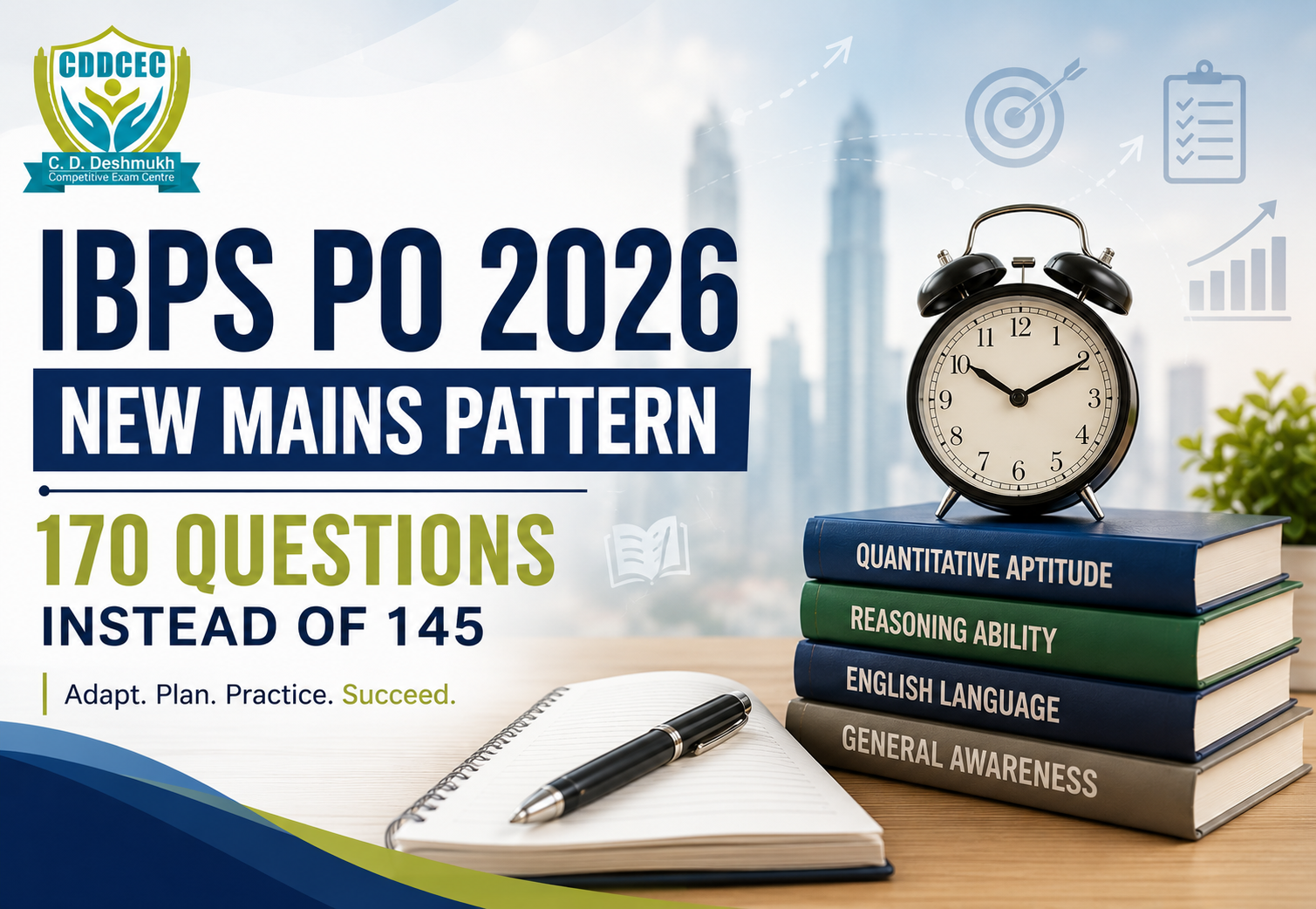
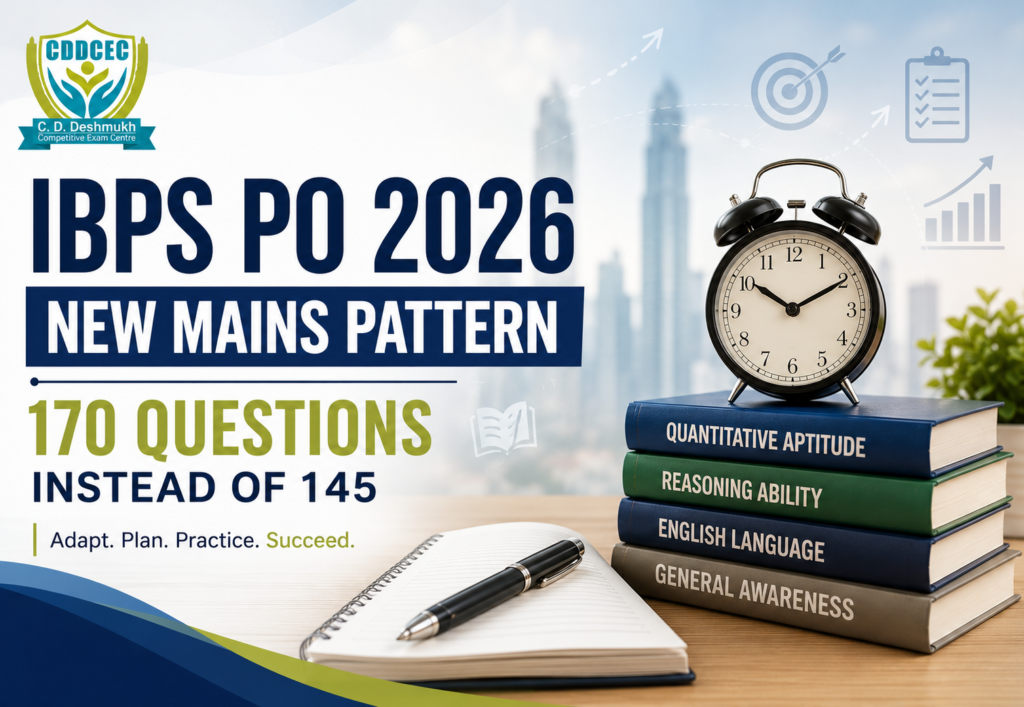
Every year, the IBPS PO exam evolves to reflect the changing demands of the banking sector. But the latest revision has caught the attention of aspirants across the country for one simple reason: the Mains examination is no longer the same. With the objective paper expanding from 145 to 170 questions, candidates now have to rethink not just what they study but also how they prepare and manage their time during the exam.
If you’ve been following the old preparation strategy, now is the time to adapt. The IBPS PO 2026 new pattern introduces changes in section-wise weightage, question distribution, and descriptive assessment, making smart preparation more important than ever. Understanding these IBPS PO syllabus changes can give you a significant advantage before the competition does.
What’s New in the IBPS PO 2026 Mains Pattern?
The most noticeable update is the increase in the number of objective questions from 145 to 170, while the total marks for the objective test remain 200. This means candidates will face more questions within a revised sectional structure, requiring greater speed, accuracy, and strategic decision-making. The General Awareness section has also expanded to include Digital and Financial Awareness, while the descriptive paper now focuses on Essay and Comprehension instead of the earlier format.
At first glance, it may seem like only the number of questions has changed. In reality, the entire approach to preparation needs an upgrade.
Why This Change Matters
Adding 25 more questions isn’t simply about increasing the workload.
It changes the way candidates allocate their preparation time, revise concepts, and attempt the paper.
Earlier, many aspirants focused heavily on a few high-scoring sections. Under the new IBPS PO 2026 pattern, each section carries greater weight because more topics are being tested, making sectional performance even more crucial.
Here’s where things get interesting. More questions don’t necessarily mean a more difficult exam. Instead, they often indicate broader syllabus coverage, requiring candidates to be consistently prepared across all subjects rather than relying on selective study.
Understanding the Key IBPS PO Syllabus Changes
While the core subjects remain familiar, there are some notable updates.
Expanded General Awareness
The General Awareness section now goes beyond traditional banking awareness.
Candidates should prepare for:
- Banking Awareness
- Economy
- Digital Banking
- Financial Awareness
- RBI Circulars
- Current Affairs
This means reading daily news alone won’t be enough. Aspirants need to understand how banking policies, financial regulations, and economic developments impact the sector.
Increased Focus on Data Analysis
Data Analysis and Interpretation continues to carry significant weight.
Expect questions involving:
- Data Sufficiency
- Caselets
- Data Interpretation
- Arithmetic Applications
- Probability
- Modern Quant concepts
Rather than solving isolated questions, candidates should practise handling mixed sets within strict time limits.
English Tests: Practical Communication
One noticeable aspect of the revised pattern is the emphasis on comprehension and communication rather than on grammar rules alone.
Vocabulary, reading comprehension, sentence improvement, and descriptive writing now require regular practice instead of last-minute preparation.
Strong reading habits can make a noticeable difference here.
Time Management Has Become Even More Important
One of the biggest challenges under the new pattern isn’t solving difficult questions. It’s making the right decisions during the exam.
With more questions to answer, candidates need to:
- Identify easy questions quickly.
- Avoid spending excessive time on one problem.
- Move efficiently between sections.
- Maintain accuracy despite increased speed.
In our experience, students often lose marks not because they lack knowledge but because they struggle with time allocation.
Regular mock tests help build this decision-making ability.
Quality Preparation Beats Quantity
Many aspirants respond to syllabus changes by increasing their study hours.
That’s rarely the best solution.
Instead, focus on improving the quality of your preparation.
A balanced strategy should include:
- Daily concept revision.
- Section-wise practice.
- Full-length mock tests.
- Analysis of mistakes.
- Current affairs revision.
- Descriptive writing practice.
Every mock test should end with an honest review of what went wrong and why.
Improvement happens during analysis, not just during practice.
Common Mistakes Students Should Avoid
The revised pattern has already encouraged many candidates to change their preparation methods. Unfortunately, some of those changes are not effective.
Ignoring New Topics
Some aspirants continue preparing according to previous years’ patterns.
The latest IBPS PO syllabus changes demand equal attention to newly expanded areas, especially Digital and Financial Awareness.
Practising Without Analysis
Completing mock tests without reviewing mistakes offers very little improvement.
Every incorrect answer reveals a concept or habit that needs attention.
Memorising Current Affairs
Reading headlines isn’t enough.
Understand why a banking policy was introduced, what an RBI circular means, and how economic developments affect financial institutions.
This deeper understanding helps during both objective questions and interviews.
Neglecting Descriptive Writing
Essay and comprehension writing require regular practice.
Many candidates postpone descriptive preparation until the final weeks, making it difficult to improve writing quality in time.
How to Adapt Your Preparation Strategy
Preparing for the IBPS PO 2026 new pattern requires a smarter routine rather than simply studying longer.
Consider dividing your weekly schedule into:
- Concept learning.
- Daily practice questions.
- Current affairs revision.
- Mock tests.
- Performance analysis.
- Descriptive writing sessions.
This balanced approach ensures consistent progress across every section.
Why Mock Tests Matter More Than Ever
Mock tests now serve a much bigger purpose than measuring scores.
They help candidates:
- Build exam temperament.
- Improve speed.
- Learn time management.
- Strengthen decision-making.
- Identify weak sections.
- Adapt to the revised pattern.
As the actual examination becomes broader, familiarity with exam conditions becomes a competitive advantage.
The Value of Expert Guidance
Preparing for competitive banking exams becomes easier when you receive structured guidance.
Experienced mentors understand how exam trends evolve and can help students prioritise topics that matter most under the revised pattern. Regular doubt-solving sessions, performance tracking, and realistic mock interviews keep preparation focused and efficient.
For aspirants looking for Bank exam classes in Thane, learning in an environment that combines updated study material, expert faculty, and disciplined preparation can make a significant difference. At CD Deshmukh Institute, students are guided by the latest exam trends, ensuring their preparation remains aligned with the evolving IBPS recruitment process.
Final Thoughts
The increase from 145 to 170 questions is more than a numerical change. It reflects a shift towards evaluating broader knowledge, stronger analytical skills, and better time management.
Candidates who understand the IBPS PO syllabus changes early and adapt their preparation accordingly will be far better positioned than those who continue following outdated strategies.
Success in the IBPS PO 2026 new pattern won’t depend on studying every hour of the day. It will depend on studying smarter, practising consistently, and preparing with a clear understanding of what the examination now expects.
With the right guidance, disciplined preparation, and a strategy built around the latest exam pattern, aspirants can approach the IBPS PO Mains with greater confidence and a stronger chance of success.